













Debate Intensifies Over Proposed Changes to B.C.’s Indigenous Rights Law
British Columbia’s plan to amend its landmark Indigenous rights legislation has ignited widespread debate among politicians, legal experts and First Nations leaders across the province.
The province’s Declaration on the Rights of Indigenous Peoples Act (DRIPA) was unanimously passed in 2019 after being co-developed with First Nations. The law requires British Columbia to align its provincial legislation with the principles outlined in the United Nations Declaration on the Rights of Indigenous Peoples (UNDRIP).
Premier David Eby has pledged to amend the act following recent court decisions that he argues have created uncertainty around how DRIPA should be applied. Eby has stated that reconciliation efforts should not be shaped primarily through judicial rulings.
Opposition From First Nations Leaders
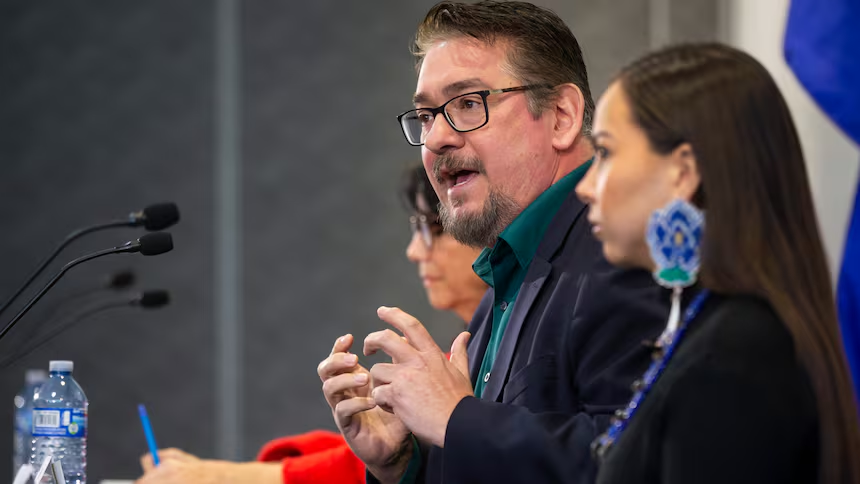
Robert Phillips, a member of the First Nations Summit political executive and of Tsq’escen’ (Canim Lake) First Nation, warned that altering DRIPA could spark significant backlash.
He described the legislation as a key implementation tool for recognizing Aboriginal rights, title and treaty rights. According to Phillips, scaling back the act would represent a major step backward and could lead to protests, direct action and further court challenges.
Phillips maintains that DRIPA remains the province’s primary framework for advancing reconciliation and argues that no alternative mechanism has been presented.
Support for Amendments
On the other side of the debate, Á’a:líya Warbus, Conservative MLA for Chilliwack-Cultus Lake and a member of the Sto:lo Nation, supports amending the act.
Warbus argues that DRIPA creates confusion by overlapping provincial law with federal implementation of UNDRIP. She emphasized that responsibility for First Nations under the Indian Act falls under federal jurisdiction, suggesting that conflating federal and provincial frameworks complicates governance.
Warbus has also raised concerns about court decisions setting precedents that may not benefit all First Nations equally, depending on how judges interpret DRIPA in individual cases.
Legal Experts Weigh In
Lawyers from Callison & Hanna have challenged the view that DRIPA creates harmful jurisdictional overlap. Darwin Hanna, a member of the Nlaka’pamux Nation, noted that First Nations have long relied on precedent-setting court cases to affirm their rights.
Cynthia Callison, a member of the Tahltan Nation, argued that recognizing Aboriginal title across the province through judicial interpretation would strengthen reconciliation, not undermine it. She emphasized that Indigenous rights protected under Section 35 of the Constitution and UNDRIP cannot be diluted by amending provincial legislation.
Callison further stated that provincial laws should be interpreted through the DRIPA framework and warned that revising the act could represent a major setback.
Broader Political and Community Response
More than 100 First Nations have reportedly urged the province to uphold DRIPA. Additionally, over 80 leaders from faith groups, labour organizations, environmental advocates, academics and artists have called on the government to pause any proposed amendments.
British Columbia is home to more than 200 individual First Nations, eight modern treaties and one historical treaty — Treaty 8 — in the northeast. In 2025, the province also negotiated an Aboriginal title agreement with the Haida Nation, marking a historic milestone.
Meanwhile, the province is appealing a recent court decision involving the Cowichan Tribes that recognized fishing rights and Aboriginal title over land in Richmond, B.C., further highlighting the legal complexities surrounding Indigenous rights in the province.
A Crossroads for Reconciliation
Supporters of DRIPA argue that it serves as a foundational “toolbox” for implementing reconciliation in British Columbia. Critics, however, believe amendments are necessary to clarify jurisdiction and prevent unintended legal consequences.
As the province moves forward, the debate underscores the ongoing tension between legislative reform, judicial interpretation and the broader goal of advancing Indigenous rights and reconciliation in British Columbia.
Post Disclaimer
The views and content presented in this article, news report, or video are solely those of the respective author or creator and do not necessarily reflect the official policy or position of BW Times Digital Online E-Paper.








Leave a comment