














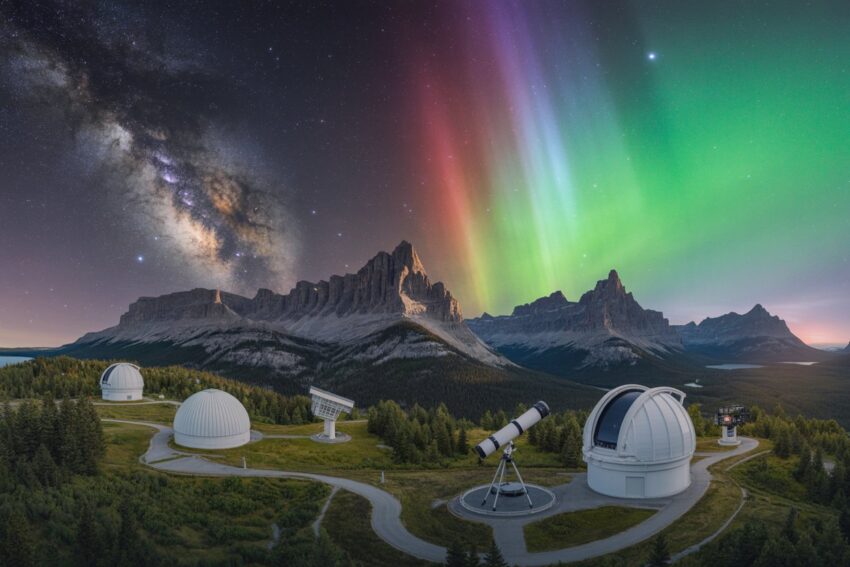
Alberta is rapidly becoming the centre of Canada’s astrotourism industry as its vast dark-sky preserves and protected landscapes attract travellers, astronomers, and astrophotographers from around the world.
The province is gaining attention for its remarkable stargazing opportunities, surpassing other Canadian regions such as British Columbia, Saskatchewan, Ontario, and Quebec in promoting night-sky tourism.
With strict light-pollution regulations and expansive wilderness areas, Alberta has positioned itself as one of the most important destinations for observing the cosmos in North America.
Canada’s Growing Astrotourism Movement
Across Canada, interest in astrotourism has surged as travellers increasingly seek destinations offering clear night skies and unique astronomy experiences.
Government agencies such as Parks Canada and provincial park authorities have helped establish protected dark-sky preserves that limit artificial lighting and allow visitors to view celestial phenomena with remarkable clarity.
These protected areas provide opportunities for stargazing, astrophotography, educational astronomy programmes, and guided telescope observations.
Today, Canada hosts more than twenty designated dark-sky locations spread across national parks, provincial parks, and remote wilderness landscapes.
Jasper National Park: A Global Dark Sky Destination
One of Alberta’s most iconic night-sky locations is Jasper National Park, home to one of the world’s largest dark-sky preserves.
Spanning more than 11,000 square kilometres in the Canadian Rockies, the park offers exceptionally dark skies due to its remote location and minimal artificial lighting.
Every year the park hosts the internationally recognised Jasper Dark Sky Festival, drawing scientists, astronomy enthusiasts, and travellers eager to witness spectacular views of the Milky Way.
The festival features telescope viewing sessions, night-sky photography workshops, and educational talks by astrophysicists.
Beaver Hills and Elk Island Expand Stargazing Opportunities
Another major astrotourism site is the Beaver Hills Dark Sky Preserve, which includes Elk Island National Park and surrounding protected landscapes.
Visitors to the preserve can observe meteor showers, distant galaxies, and the aurora borealis while participating in astronomy interpretation programmes organised by park officials.
These experiences combine science education with outdoor tourism, making the region increasingly popular with families and amateur astronomers.
Wood Buffalo National Park: World’s Largest Dark Sky Preserve
Alberta’s astrotourism reputation is further strengthened by Wood Buffalo National Park, which stretches into the Northwest Territories.
The park is widely recognised as the largest dark-sky preserve in the world, offering unmatched viewing conditions for stargazing and astrophotography.
Its remote northern location allows visitors to experience some of the clearest night skies on the planet.
Other Canadian Provinces Strengthen Stargazing Tourism
While Alberta has taken a leading role in astrotourism, other Canadian provinces continue expanding their own dark-sky initiatives.
In Saskatchewan, Grasslands National Park offers some of the darkest skies in North America, making it a favourite location for observing the Milky Way.
Meanwhile, Ontario is home to the historic Torrance Barrens Dark Sky Preserve, the country’s first officially designated dark-sky site.
Quebec also contributes to Canada’s astronomy tourism industry through the internationally recognised Mont‑Mégantic International Dark Sky Reserve, which includes a major research observatory and astronomy science centre.
These destinations offer travellers educational programmes, telescope observation events, and guided night hikes.
Astrotourism Becoming a Major Travel Trend
Astrotourism is now emerging as one of the fastest-growing segments of Canada’s travel industry.
Remote wilderness landscapes, strict environmental protections, and growing interest in space exploration have made the country an ideal destination for night-sky tourism.
Visitors increasingly travel to dark-sky preserves to photograph celestial phenomena, observe meteor showers, and experience the beauty of the Milky Way far from city lights.
From the Rocky Mountains to the Atlantic coast, Canada’s protected night skies are becoming one of the country’s most extraordinary natural attractions.
With Alberta’s expanding network of dark-sky preserves leading the way, the province is now firmly positioned at the forefront of the country’s astrotourism movement.
Post Disclaimer
The views and content presented in this article, news report, or video are solely those of the respective author or creator and do not necessarily reflect the official policy or position of BW Times Digital Online E-Paper.








Leave a comment