













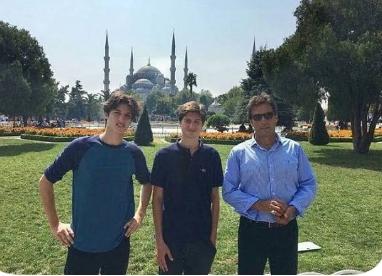
In a recent press briefing, Pakistan’s Information Minister Atta Ullah Tarar discussed the situation involving former Prime Minister and legendary cricketer Imran Khan’s sons, Qasim Khan and Suleman Khan. According to the minister, if Imran Khan’s sons wish to visit Pakistan to meet their father, they are welcome to do so using their National Identity Card for Overseas Pakistanis (NICOP).
However, complications arose when Qasim and Suleman attempted to enter Pakistan using NICOP. Reports suggest that their cards were either lost or invalid, prompting them to contact the Pakistan Consulate in the United Kingdom to renew or issue new NICOP cards. Despite repeated requests, the government allegedly refused to assist, providing multiple excuses. The brothers then applied for a visa to enter Pakistan, but their application was also reportedly rejected with various explanations.
Suddenly, the government’s stance appears to have shifted. Officials now indicate that Qasim and Suleman can enter Pakistan as Pakistani citizens using NICOP, signaling a possible change in policy. Observers suggest that this shift could be a strategic move, allowing authorities to track their movements and potentially create legal pressure in the future. Analysts point out that recent changes in laws may make it easier for the government to pursue legal cases against individuals who enter the country as Pakistani citizens under such agreements.
While the government appears to be opening the door for their entry, it is unclear whether Qasim and Suleman are willing to return. Sources indicate that the brothers may be hesitant to come due to the potential for massive public gatherings in their support, which could create political and security challenges. Their return could ignite large demonstrations and public attention, placing both the family and authorities in a delicate situation.
Political analysts note that the situation reflects the broader tension between the government and Imran Khan. By controlling the entry process through NICOP regulations, authorities have the ability to monitor movements and potentially influence public perception. Critics argue that such measures may be designed to exert pressure on the family while maintaining legal cover under Pakistani citizenship laws.
The Information Minister emphasized that Pakistan remains open to all citizens, including those living abroad, but the NICOP requirement remains mandatory for overseas Pakistanis wishing to enter the country without a visa. This clarification comes amid growing speculation about whether Imran Khan’s sons will take advantage of the new policy or remain abroad to avoid confrontation.
As the political and legal dynamics continue to unfold, the eyes of the nation remain on Qasim and Suleman Khan. Their decision to return or stay abroad could have significant implications for their father’s political legacy and for the broader political landscape in Pakistan. Observers suggest that the coming weeks will be critical in determining whether this situation escalates into a larger political and public spectacle.
The government’s sudden policy shift has raised questions about strategy, legal implications, and the potential for public reaction. Meanwhile, Imran Khan’s sons face a complex decision between family obligations and political realities, balancing personal choices with national attention.
Post Disclaimer
The views and content presented in this article, news report, or video are solely those of the respective author or creator and do not necessarily reflect the official policy or position of BW Times Digital Online E-Paper.










Leave a comment