










Alberta’s First Nations leaders were not laughing with anyone this week — they were laughing at Jeffrey Rath.
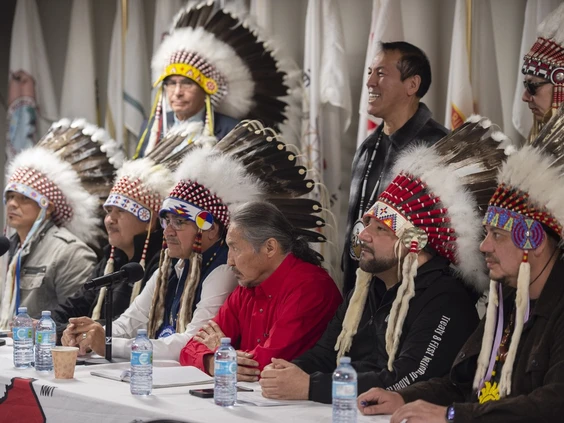
Rath, a lawyer who has emerged as one of the most vocal figures in Alberta’s separatist movement, was the subject of open derision from Indigenous leaders during a news conference at the Treaty 8 First Nations of Alberta offices in west Edmonton. Rath was not present.
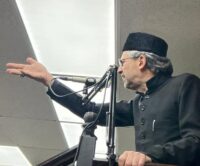
Just days earlier, speaking at a Stay Free Alberta event held in a nearby hotel, Rath claimed that Indigenous people would be far better off in an independent Alberta.
“We’ll triple the amount of money spent on the Indigenous people of Alberta through a constitutionalized revenue-sharing program,” Rath said at the event. “We’ll lift them out of the abject poverty that Ottawa has left them in for more than 100 years.”
On Thursday, leaders from Treaty 6, 7, and 8 territories publicly rejected those claims and presented a united front against the Alberta independence petition — a campaign that could trigger a referendum under the province’s Bill 14, which allows citizen-led initiatives.
The Sturgeon Lake Cree Nation, the Blackfoot Confederacy, and the Athabasca Chipewyan First Nation have all launched legal challenges against the petition and Bill 14. The Mikisew Cree Nation says it plans to do the same.
Chief Billy-Joe Tuccaro of the Mikisew Cree Nation said Rath’s comments were particularly ironic, given his history representing First Nations in lawsuits against the federal government — including cases that reached the Supreme Court of Canada.
“He’s going to state we’d benefit a lot more,” Tuccaro said. “That’s funny that he would state that publicly when, at times, he represented a lot of us.”
Those relationships, Tuccaro said, eventually broke down over disputes about payment for Rath’s legal work. In 2025, the Mikisew Cree Nation won a lawsuit eliminating Rath’s claim to contingency fees. Tallcree First Nation and Sturgeon Lake Cree Nation also sued him.
Chiefs also expressed concern over claims by the Alberta Prosperity Project — which Rath represents — that its leadership has met repeatedly with U.S. State Department officials and explored the possibility of American-backed credit guarantees to support a newly independent Alberta.
Beyond politics, leaders said the independence push is already fueling racial tensions across the province.
Chief Troy “Boss Man” Knowlton of the Piikani Nation described incidents at hockey games, restaurants, and other public spaces where arguments over separatism have escalated into hostility directed at Indigenous people.
“Our First Nations spectators are willing to defend themselves,” Knowlton said. “They’re willing to call out the hatred and racism we’re seeing — and it’s happening at hockey games, diners, everywhere.”
At the heart of the legal challenge, First Nations leaders argue, is the question of jurisdiction.
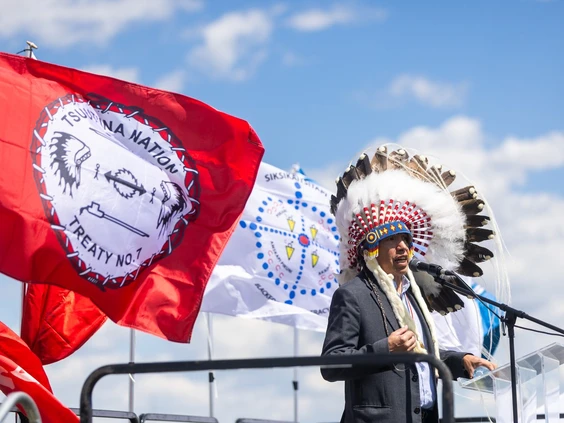
Treaty 8 Grand Chief Trevor Mercredi said Alberta has no authority to sanction an independence vote because the treaties governing the land predate the province itself. The treaties were signed in the 19th century with the Crown, before Alberta became a province in 1905.
“Alberta does not have jurisdiction over our lands,” Mercredi said. “Our lands must be respected. Our chiefs and councils have stated time and time again that separation will not happen here in Alberta.”
“What we’re seeing is a disregard for our treaties and a misunderstanding of how Alberta even became a province,” he added.
Allan Adam, chief of the Athabasca Chipewyan First Nation, underscored that point, noting that Indigenous peoples never agreed to separation.
“The oil and gas belong to First Nations,” Adam said. “We signed a treaty to share it with you. We didn’t sign a treaty for separation.”
The Alberta independence movement is currently collecting signatures in hopes of forcing a referendum. First Nations leaders say they will continue to fight the effort in court — and reject any suggestion that Alberta’s future can be decided without them.
Post Disclaimer
The views and content presented in this article, news report, or video are solely those of the respective author or creator and do not necessarily reflect the official policy or position of BW Times Digital Online E-Paper.





Leave a comment