

















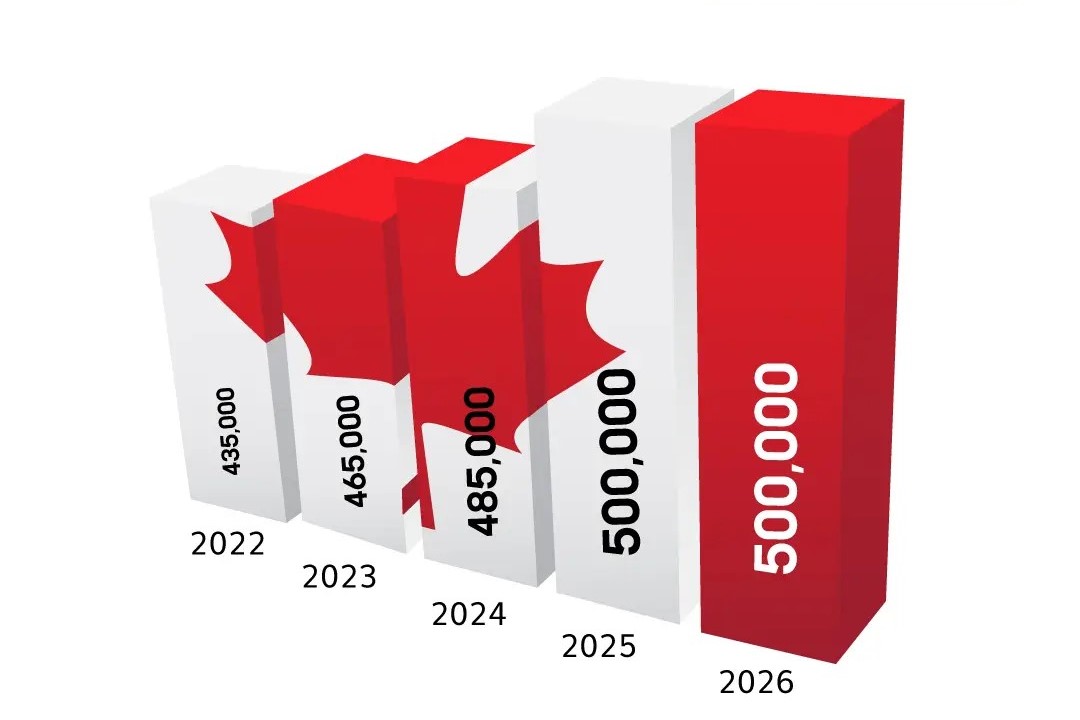
Canada has entered a new phase in its immigration system, with significant policy changes introduced for 2025 and 2026. These updates reflect a shift in priorities by the federal government, aiming to balance population growth, economic needs, and pressure on housing and public services. The new approach affects both temporary residents, such as work permit holders, and those applying for permanent residence.
One of the most important changes is the adjustment in overall immigration targets. Canada continues to welcome a large number of permanent residents each year, but the government is now placing greater emphasis on managing the number of temporary residents. This includes international students and foreign workers. The goal is to reduce the proportion of temporary residents in the country over the next few years while maintaining steady permanent immigration levels. As a result, the system now favors individuals who are already living and working in Canada and are ready to transition into permanent residency.
Work permit policies have become stricter under the new framework. Employers who want to hire foreign workers must now meet more rigorous requirements. They must clearly demonstrate that they made genuine efforts to hire Canadian citizens or permanent residents before offering a job to a foreign worker. This is done through the Labour Market Impact Assessment process, which has become more detailed and closely monitored. Authorities are focusing especially on preventing misuse of the system in lower wage sectors, where concerns about worker exploitation and job displacement have been raised.
In addition to employer requirements, foreign workers themselves face higher expectations. Wage thresholds have increased in many sectors, meaning that employers must offer salaries that meet or exceed updated standards. This ensures that foreign workers are not hired at lower wages than local workers. There are also stronger verification procedures in place, making it more important for applicants to provide accurate documentation and proof of qualifications. Financial requirements have also become more structured in some cases, especially for those entering Canada through specific programs.
Another notable development is the push toward regional immigration. Canada is encouraging newcomers to settle outside major urban centers such as Toronto, Vancouver, and Montreal. Smaller cities and rural areas are facing labor shortages and population decline, so new policies aim to direct foreign workers to these regions. Special programs and pilot projects have been designed to support this effort, offering pathways for workers who are willing to live and work in less populated areas. This shift is intended to distribute economic benefits more evenly across the country.
Changes have also been made to family-related work permits. Previously, many foreign workers could bring their spouses to Canada with open work permits, allowing them to work for any employer. Under the updated rules, eligibility for these spousal work permits has been restricted. Now, only certain categories of workers, typically those in higher skilled occupations, can extend this benefit to their spouses. This change is part of a broader effort to manage the number of temporary residents entering the country.
A major highlight of the new immigration strategy is the introduction of expanded pathways from temporary status to permanent residence. The government recognizes that many temporary workers are already contributing to the economy and have integrated into Canadian society. As a result, new programs have been introduced to help these individuals become permanent residents more easily. These pathways are particularly focused on workers in essential industries and those with Canadian work experience. The idea is to retain talent that is already proven and established within the country.
The Express Entry system, which is one of the main routes to permanent residence, has also undergone important changes. Instead of relying solely on a points based ranking system, the government has introduced category based selections. This means that candidates are now invited based not only on their overall score but also on their occupation or skills. Priority is given to individuals working in high demand fields such as healthcare, transportation, and technical professions. This targeted approach allows Canada to address specific labor shortages more effectively.
Provincial Nominee Programs have been expanded as well, giving provinces greater authority to select immigrants based on their local economic needs. Each province can now tailor its immigration streams to attract workers in sectors where there are shortages. This creates more opportunities for applicants who may not qualify through federal programs but meet the requirements of a particular province. For example, provinces like Alberta and Saskatchewan are actively seeking workers in industries such as agriculture, construction, and energy.
Another key aspect of the new policy direction is the reduction of new temporary permits. The government has announced plans to limit the number of new work permits and study permits issued each year. This is intended to control population growth in major cities and reduce pressure on housing, healthcare, and infrastructure. While this may make it more difficult for new applicants to enter Canada, it improves the chances for those already in the country to secure long term status.
In addition to these structural changes, there have been adjustments to fees and processing systems. Some application fees have increased, reflecting the administrative costs of managing immigration programs. At the same time, efforts are being made to modernize processing systems and reduce wait times. Digital tools and automation are being introduced to make the system more efficient and transparent.
Overall, the new immigration policies represent a shift from quantity to quality and sustainability. Canada is still committed to welcoming immigrants, but the focus is now on selecting candidates who can quickly integrate into the workforce and contribute to the economy. There is also a clear intention to ensure that immigration levels are aligned with the country’s capacity to provide housing and services.
For individuals outside Canada, these changes mean that obtaining a work permit has become more competitive. A strong job offer, supported by proper documentation and meeting wage requirements, is now more important than ever. For those already in Canada, however, the situation is more favorable. With new pathways to permanent residence and targeted selection systems, they have a better chance of securing long term status.
In summary, Canada’s updated immigration system is designed to be more controlled, more selective, and more responsive to economic needs. It prioritizes individuals who are already contributing to the country while ensuring that future immigration supports sustainable growth.
Post Disclaimer
The views and content presented in this article, news report, or video are solely those of the respective author or creator and do not necessarily reflect the official policy or position of BW Times Digital Online E-Paper.












Leave a comment