


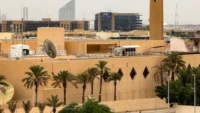
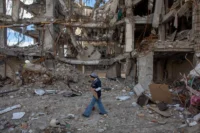












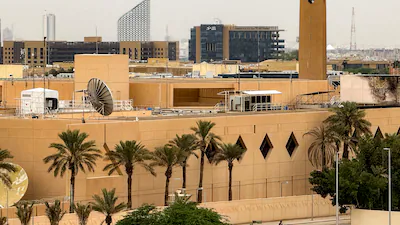
A new report has intensified attention on the growing regional confrontation after claims emerged that a two drone strike linked to Iran directly damaged a highly sensitive section inside US Embassy Riyadh.
According to details circulating from security sources, the attack happened during the early hours of the night when two drones arrived in extremely short succession over the diplomatic quarter of Riyadh.
The first drone reportedly struck the embassy compound shortly after 1:30 in the morning.
Approximately one minute later, a second drone followed almost the same path and entered through the opening created by the first explosion before detonating deeper inside the structure.
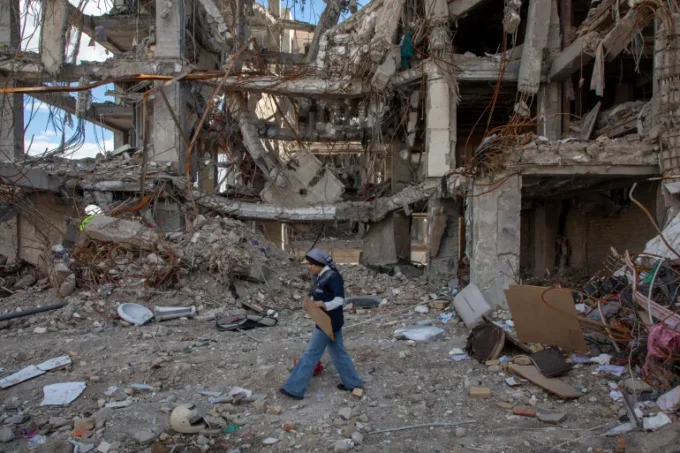
That sequence reportedly caused major internal damage across multiple floors.
The most serious claim in the report is that one of the damaged areas included a section identified by security sources as connected to sensitive American intelligence operations.
Although official public descriptions initially described the damage as limited, later reports suggested that several floors suffered far heavier destruction than first acknowledged.
According to those accounts, fire continued for several hours after impact and parts of the affected structure may no longer be fully usable.
The embassy compound, like most diplomatic missions abroad, does not operate its own independent missile defence and relies largely on host country protection.
That has raised questions about how the drones crossed defended airspace in one of the most protected zones of Saudi Arabia.
Security analysts note that the diplomatic quarter sits close to major state protected zones where high level air defence systems are already active.
This has increased scrutiny of how low altitude drone penetration was achieved.
The same night reportedly included another attempted strike near the residence used by the most senior American diplomat stationed in Saudi Arabia.
That location is only a short distance from the embassy compound, making the timing especially significant.
The broader military context is equally important.
Since late February, regional military exchanges have expanded sharply, with multiple American linked facilities across the Middle East reporting missile or drone related incidents.
Several strategic sites in Iraq, United Arab Emirates, and Kuwait have also faced pressure during the same conflict period.
Attention has also focused on Prince Sultan Air Base, where previous strikes reportedly affected aircraft and support infrastructure used by American forces.
Military observers say the Riyadh embassy incident matters because diplomatic compounds are usually considered symbolically powerful targets.
A successful penetration of such a compound carries strategic messaging beyond physical damage.
It signals reach, timing precision, and the ability to challenge high security assumptions.
The alleged use of two drones in coordinated sequence also reflects increasingly sophisticated tactical planning.
The first strike appears designed to weaken structural protection, while the second maximized internal damage.
This pattern resembles methods seen in modern precision drone conflict where timing becomes as important as explosive power.
Politically, the incident may increase pressure for stronger defensive coordination between Saudi Arabia and the United States.
It also raises concern for diplomatic missions throughout the region because embassies traditionally depend heavily on host nation security architecture.
So far, no confirmed American fatalities have been linked to the embassy strike itself, largely because the incident happened during low occupancy hours.
Officials privately acknowledge that timing prevented potentially much greater casualties.
For global observers, the larger concern is that diplomatic infrastructure is now clearly inside the conflict zone.
Courtesy: ndtv
Post Disclaimer
The views and content presented in this article, news report, or video are solely those of the respective author or creator and do not necessarily reflect the official policy or position of BW Times Digital Online E-Paper.











Leave a comment